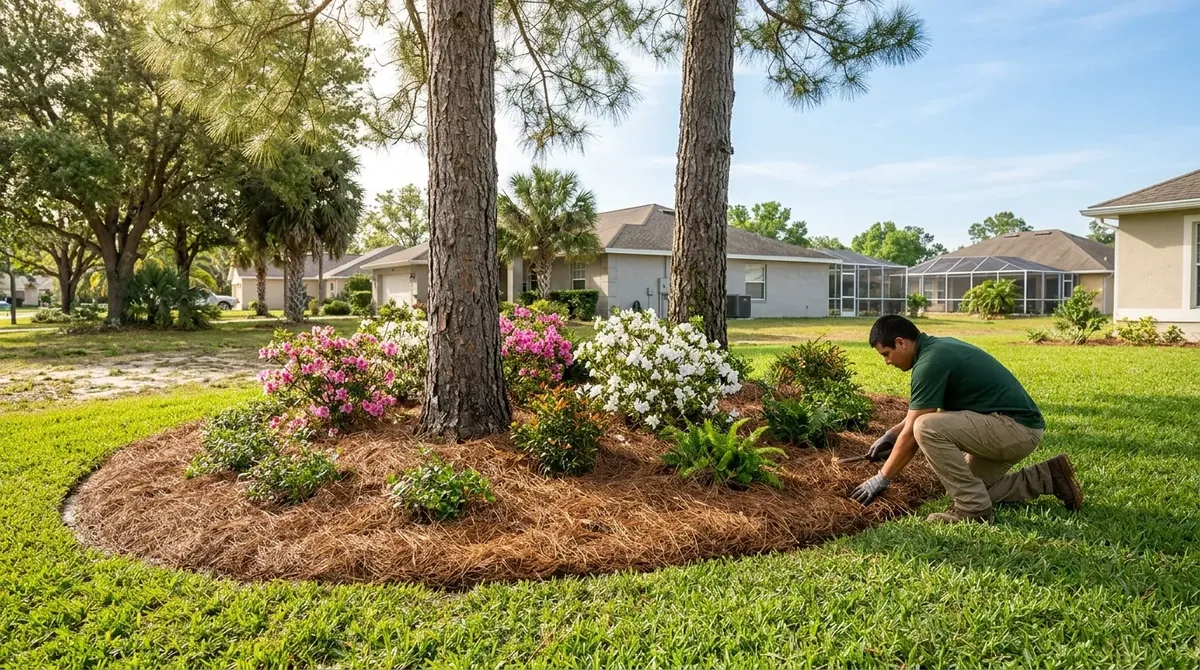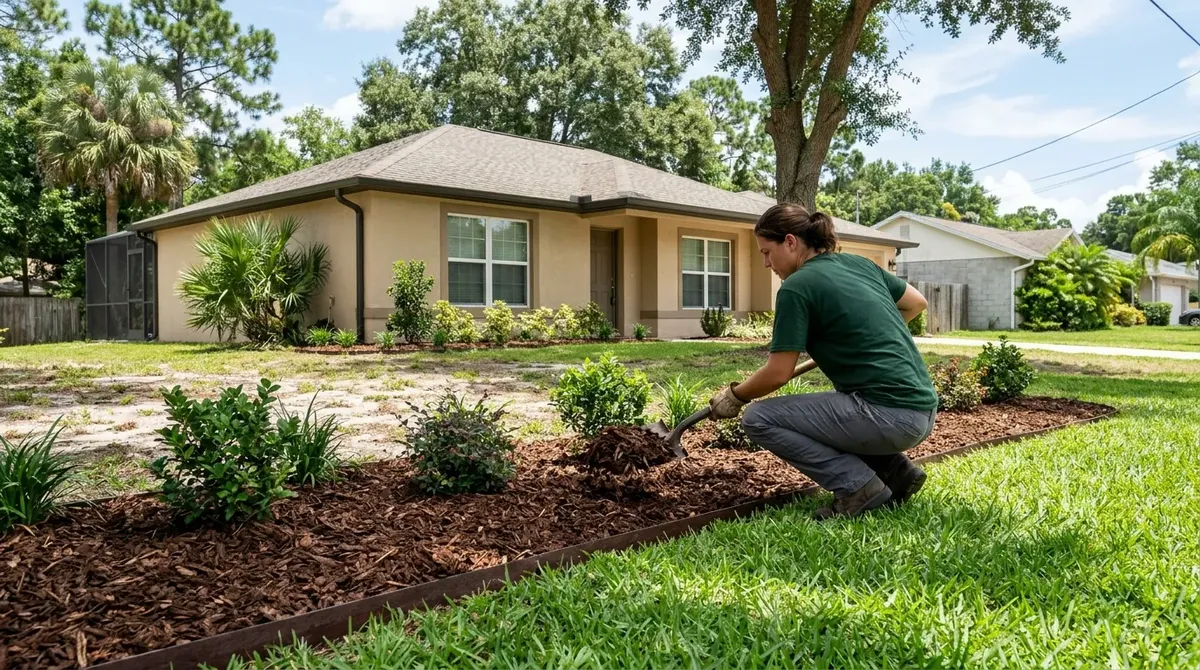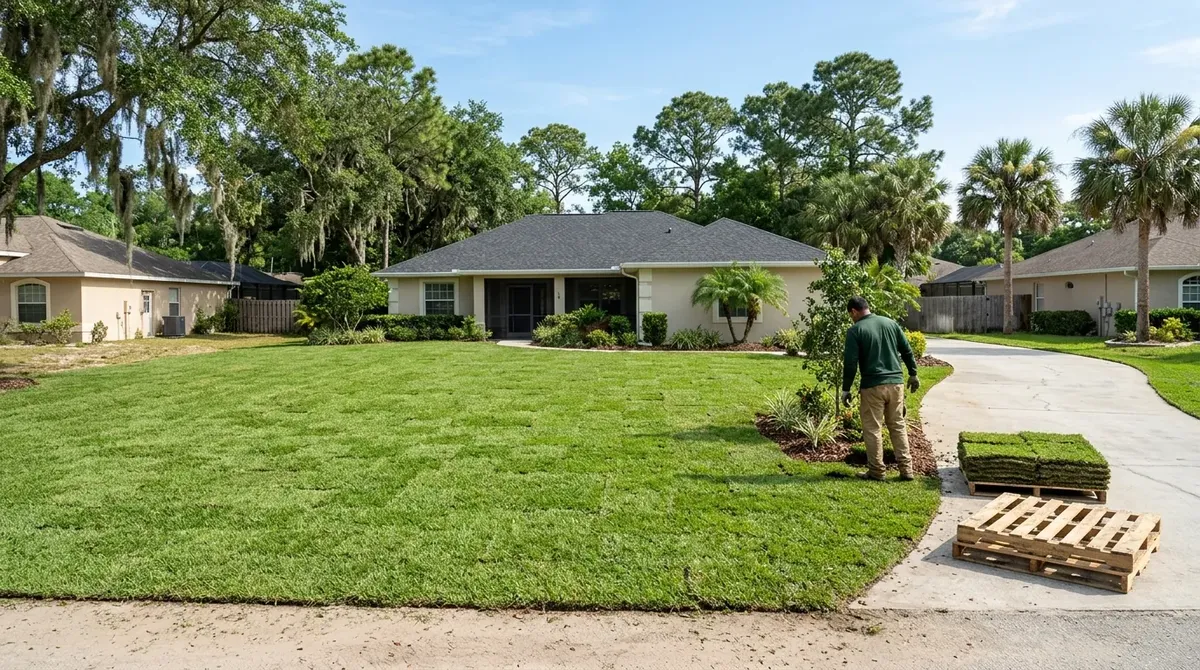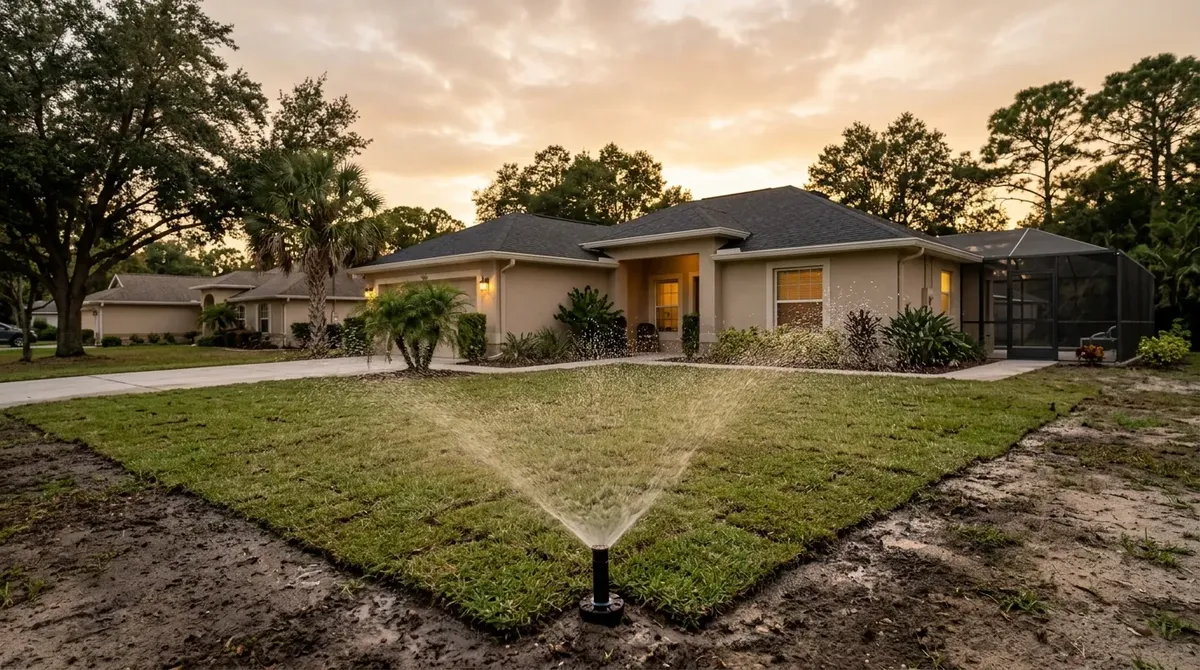
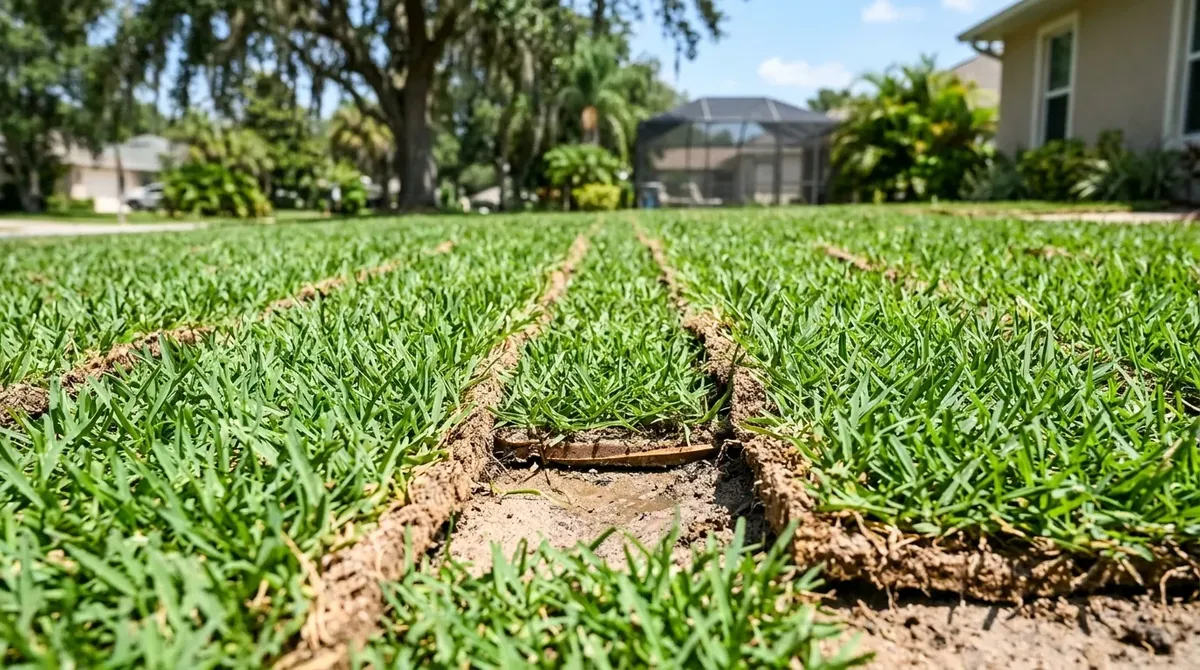
Some browning in the first couple of weeks is normal as cut roots settle in. What matters is the pattern: where the brown is, how fast it spreads and what the soil under it feels like. Start with the quick-check table, then jump to the cause that fits.
New Sod Turning Brown: Quick Diagnosis Table
| What you see | Most likely cause | Quick check |
|---|---|---|
| Brown lines along seams; slab edges curling | Drying out, gaps between slabs | Peel a corner; dry sand underneath |
| Whole lawn dull blue-gray, footprints stay | Too little water | Blades folded; soil dry an inch down |
| Soggy ground, yellowing, round patches in cool weather | Too much water, large patch | Squishy soil; blades pull off and smell rotten |
| Thinning that worsens over weeks in one shady area | Shade on Floratam | Count hours of direct sun |
| Spreading brown patches in hot, sunny spots by walks or the driveway | Chinch bugs | Coffee can float test |
| Oblong leaf spots, lawn looks drought-stressed in summer | Gray leaf spot | Spots with gray fuzzy centers after humid nights |
| Irregular declining areas in very sandy soil that don't respond to water | Sting nematodes | Lab soil assay |
1. Brown New Sod From Dry Seams and Gaps
The seams are the first place new sod dries. Each slab has cut edges with no roots in the soil yet, and Lakeland's sandy ground drains fast. If slabs were laid with gaps, or if they shrink a little in the first hot week, the edges curl, the gap opens and both sides brown. UF/IFAS guidance is to lay sod in a staggered brick pattern on moist soil with edges pushed tight, then roll it so roots touch the ground.
Fix: water the seams first, press curled edges down, and fill any real gaps with strips cut from leftover sod rather than loose sand. Seams that green up within a week or so were just thirsty. If a whole section never knits, it may need relaying. Good sod installation prevents most of this before the first watering.
2. New Sod Watering Problems Under the One-Day Rule
Polk County is under a SWFWMD water shortage order through March 31, 2027, and the most common mistake is assuming new sod gets the same one day a week as an established lawn. It doesn't. For its first 30 days, new sod may be watered daily inside your allowed night window; days 31 to 60 drop to a three-day rotation. Check SWFWMD or your utility for the current order. Once the District lifts it, Lakeland's regular two-day schedule returns. Each step is laid out in our Polk County guide to watering new sod.
Too little water
UF/IFAS lists folded blades, a blue-gray tint and footprints that stay pressed in as signs a lawn needs water. On new sod you will also see slab edges lift. A single long run once a night often isn't enough in the first ten days. Several short cycles inside one window keep the root zone damp much better.
Too much water
Overwatering browns sod too, just more slowly. Soil that stays soggy starves roots of air and favors dollarweed, sedges and disease. On flatwoods lots with a hardpan, water can sit for hours after a storm. If the ground squishes, skip a cycle and let the rain sensor do its job.
3. Shade Browning on New Floratam Sod
Floratam needs six hours or more of direct sun daily to hang on, according to UF/IFAS. New Floratam laid under a big oak can look fine for a month or two and then thin steadily, since it never builds enough roots to hold on. This is common in older neighborhoods with mature canopy, like the streets around Lake Hollingsworth and Dixieland.
Fix: replace the shaded section with a shade-tolerant St. Augustine such as CitraBlue, ProVista or Seville, raise the mowing height, or turn the darkest areas into mulched beds. See choosing grass for Lakeland sun and shade for options, and St. Augustine sod compares the shade cultivars.
4. Chinch Bug Damage on New St. Augustine Sod
Southern chinch bugs are the major insect pest of St. Augustine in Florida. Floratam, released in 1973, originally resisted them, but UF/IFAS says that resistance has largely been lost, and Seville is also susceptible. It usually appears first when the weather heats up, in hot, water-stressed, full-sun spots along sidewalks, driveways and buildings, as browning patches that spread outward.
The UF/IFAS check: cut both ends off a coffee can, push it into the turf at the edge of a damaged patch, fill it with water and watch. Chinch bugs float to the surface within about five minutes. If you find them, treat the problem area rather than the whole yard, and note that some chinch bug populations resist pyrethroid insecticides. Don't mistake dry seams for bugs, since both start in the hottest spots.
5. Gray Leaf Spot on New Sod in Lakeland Summers
Gray leaf spot is a fungal disease of St. Augustine that runs mostly from May through September, during the rainy season. UF/IFAS notes it moves fastest on the lush, tender tissue common in newly sprigged or establishing sod. Look for oblong spots on the blades. After warm, humid nights, the centers can show a gray, felt-like growth. In a bad case, the lawn can look like it is suffering from drought.
Fix: don't push new sod with nitrogen. For 30 days after sodding, Polk County's rules keep nitrogen and phosphorus off the lawn, and UF/IFAS suggests stretching that to 30 to 60 days since the farm already fed the sod. Water in the overnight window rather than adding extra cycles, and have a sample checked before buying fungicide.
6. Large Patch on New Sod in Cool Months
Large patch is the cool-season disease. UF/IFAS says symptoms are most often seen from November to May when temperatures fall below 80 degrees, and moisture is the main driver: overwatering, heavy rain and blades that stay damp for two days or longer. It shows up as round, discolored patches that expand, often with darker or orange borders where the fungus is active. Affected blades pull easily off their stems and smell of rot. St. Augustine and zoysia, including Empire, are hit hardest.
Fix: water only when needed and in the early-morning window, go easy on nitrogen, and mow affected areas last so you don't spread it. UF/IFAS recommends confirming large patch at a plant clinic before treating, since several problems look alike.
7. Sting Nematodes in Lakeland's Sandy Soils
Sting nematodes are microscopic worms that feed on grass roots, and they live in very sandy soil rather than heavy clay. That puts the deep sands on higher ground around south Lakeland on the list, including much of Lakeland Highlands. Symptoms are irregular, declining areas that don't respond to water or fertilizer and look like several other problems. UF/IFAS is clear that only a lab soil assay confirms them.
Grass choice helps. Floratam's thick roots let it put up with sting nematodes better than finer-rooted cultivars, and in UF/IFAS work Celebration Bermuda held up better than Tifway. If a lab confirms nematodes in an area that keeps failing, sod removal and replacement with a better-matched grass is often the practical answer.
Brown New Sod That Isn't a Problem Yet
- Winter dormancy. St. Augustine goes tan and dormant in cool weather in parts of Florida. Sod laid in December or January can look brown until spring and still be alive. Give it until spring growth before you judge it.
- Fertilizer burn from feeding too soon. This one is a real problem, but an avoidable one. Skip fertilizer for at least 30 days, and up to 60 days per UF/IFAS.
- Transplant shock in week one. A slight dulling right after installation is normal. It should fade as roots peg down, which UF/IFAS puts at 14 to 21 days.
How to Check New Sod in Lakeland Before You Treat Anything
- Tug a slab. At 14 to 21 days it should resist. If it lifts like a rug, roots haven't formed, and water or timing is the likely issue.
- Peel back a corner in the morning. Dry sand means more water; soggy sand means less.
- Note the pattern: seams, sunny edges, shade, or round patches.
- Run the coffee can test at the edge of any spreading patch in sun.
- Bring a sample to the Polk County UF/IFAS Extension plant clinic before buying fungicide or insecticide.
If a whole section has failed, or you just want a second set of eyes, we look at brown sod during a free on-site estimate and give you a fixed written price for any fix. Our homepage covers sod in Lakeland and nearby towns, or you can request a visit.