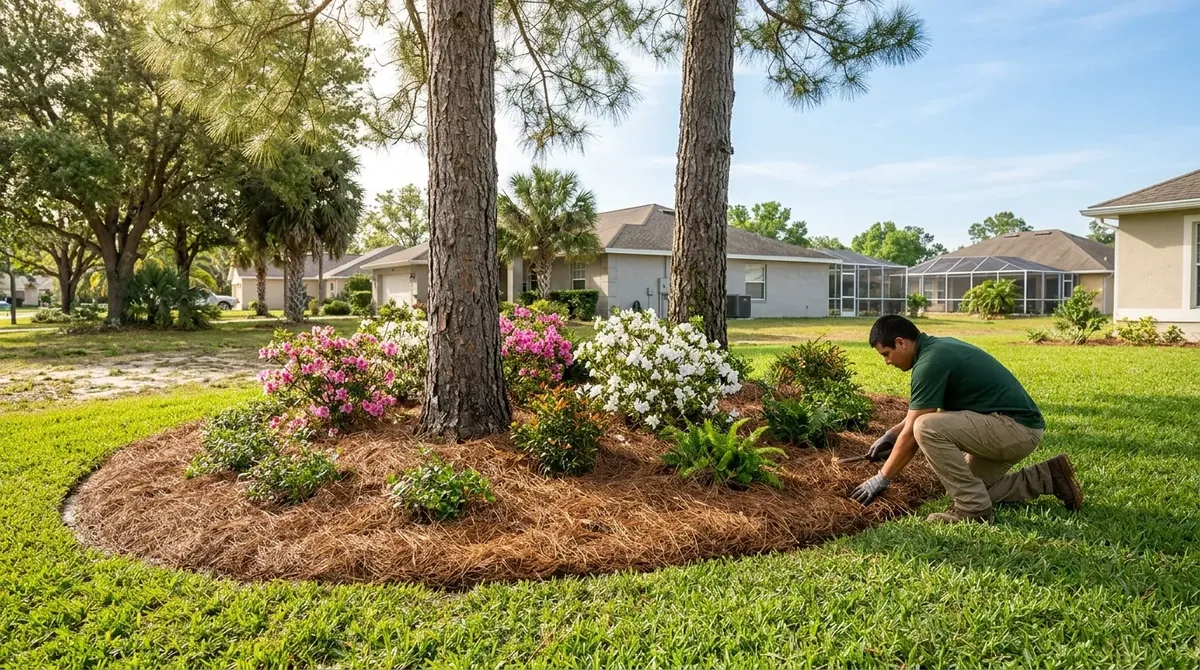
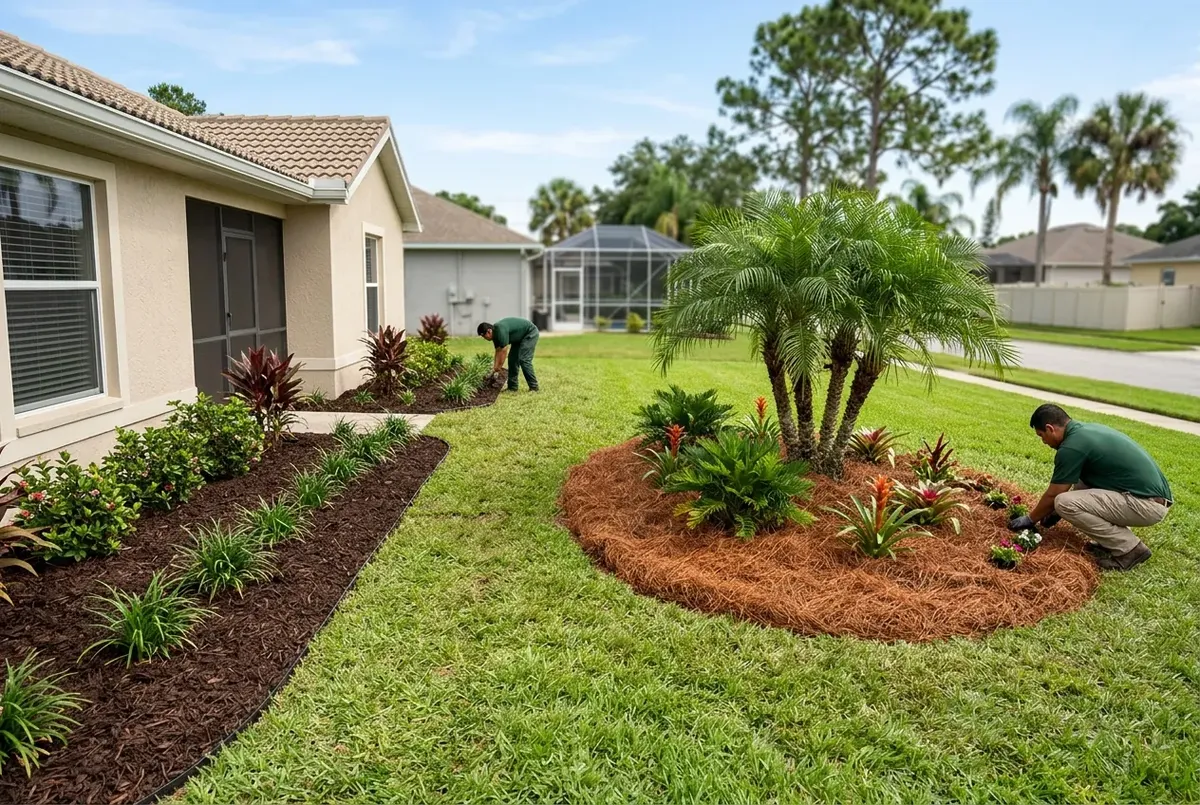
Walk any Lakeland street and you will see both: rust-red pine straw under longleaf pines and azaleas, and dark bark mulch in tidy front beds. Neither is wrong. They just solve different problems, and the cost gap between them is bigger than most people expect.
Pine Straw vs. Mulch in Florida: Side by Side
| Material | Durability | Stays put on slopes | UF/IFAS take | Good for |
|---|---|---|---|---|
| Pine straw | Breaks down fast; re-mulch often | Very well; needles knit together | Inexpensive, natural, resists washing away | Slopes, pine islands, natural beds |
| Pine bark | Slow to break down; roughly two-thirds remains after two years | No special advantage | Rich color, long-lasting | Front beds, foundation plantings |
| Eucalyptus | Outlasts pine straw | No special advantage | Grown on Florida farms; considered renewable | General beds |
| Melaleuca | Outlasted pine bark and cypress in UF testing | No special advantage | Made from an invasive tree, heat-cured | Beds where you want fewer top-ups |
| Dyed hardwood | Depends on the base wood | No special advantage | Dye isn't the problem; recycled wood with CCA-treated lumber can be | Ornamental beds, with MSC-certified product |
| Cypress | Durable | No special advantage | Not recommended by Florida-Friendly Landscaping | Skip it |
| Rubber | Very durable | Poor; can float and wash away | Not recommended for beds | Skip it |
| Rock | Permanent | Can migrate onto lawns | For paths, dry creek beds and downspouts only | Hardscape areas over fabric |
Mulch and Pine Straw Cost in Lakeland per 1,000 Sq Ft
Using UF/IFAS coverage math, 1,000 sq ft at 3 inches takes about 9.26 cubic yards of mulch. The same area takes about 25 to 30 bales of pine straw at 2 to 3 inches. Here is how typical Lakeland-area ranges compare:
| Option for 1,000 sq ft | Typical range | What moves the price |
|---|---|---|
| Pine straw, installed (25 to 30 bales) | $175 to $360 | Bale count, needle type, how many beds |
| Bulk mulch, delivered only (about 9.3 yards) | $370 to $700 | Mulch type, delivery distance; you spread it |
| Mulch, installed (about 9.3 yards) | $650 to $1,200 | Pine bark vs. eucalyptus vs. dyed, edging, weeding |
| River rock, installed | $150 to $260 per ton | Rock size, fabric, how much the area needs |
These are typical ranges, not quotes. Pine straw's lower upfront cost is partly offset by more frequent top-ups, since it breaks down faster than bark. If you want to work out your own beds, use the formulas in how much mulch do I need.
Pine Straw Installation for Lakeland Slopes and Washouts
Lakeland gets most of its rain in summer thunderstorms, and a hard afternoon downpour can carry loose bark nuggets right off a sloped bed and into the street. UF/IFAS notes that pine needles knit together and resist washing away, which is why pine straw is the go-to for berms, banks along a driveway, and beds under a roof edge with no gutter. It also lays well as a thin layer in wildflower areas. It is a natural match for the pine-shaded lots common on the sandy high ground in places like Lakeland Highlands.
The tradeoff is lifespan. Straw breaks down faster than any wood mulch, so plan on refreshing it more often. As it breaks down, it adds organic matter to sandy soil. Our pine straw installation page covers how we tuck edges so it stays put.
Best Bark Mulch Options for Polk County Beds
Pine bark
Pine bark has a rich brown color and settles slowly. UF/IFAS says about two-thirds of the original depth is still there after two years, which makes it a good fit for front beds you want to look the same season after season.
Eucalyptus and melaleuca
Both are Florida-sourced options UF/IFAS speaks well of. Eucalyptus is grown on Florida farms for mulch and is considered renewable. Melaleuca is made from an invasive tree and heat-cured, and it outperformed pine bark and cypress in a UF/IFAS durability study.
Dyed red, brown and black mulch
UF/IFAS found no evidence that the dye harms soil. The concern is the wood underneath, since some dyed products are made from recycled lumber that may include CCA-treated wood. Look for the Mulch and Soil Council (MSC) certification logo on the bag or ask the supplier, and keep dyed mulch out of vegetable gardens. We spread MSC-certified dyed mulch as one of our mulch installation options.
Mulch to Skip in Florida Beds: Cypress and Rubber
Cypress mulch looks good and lasts, but the Florida-Friendly Landscaping program does not recommend it. Its origin is hard to trace, and it may come from trees cut in forested wetlands. Melaleuca or eucalyptus give you similar durability without that question.
Rubber mulch lasts almost forever, and that is about the only point in its favor for planting beds. UF/IFAS lists poor weed control, heat absorption, a tendency to float and wash away, and possible leaching, and does not recommend it for beds.
Landscape Rock in Lakeland: Where It Belongs
Rock, gravel and shell never need topping up, but UF/IFAS points out they add no nutrients, hold no water, do a poor job controlling weeds and heat, and creep into lawns. UF reserves them for pathways, dry creek beds and the splash zone under downspouts, laid over landscape fabric. That is how we use river rock and lava rock too. See landscape rock for those jobs.
Termites, Mulch and Pine Straw: What UF/IFAS Says
This question comes up with every material. Florida soil is home to termites with or without mulch, and mulch doesn't put them there. It does keep the soil moist and mild, so termites may be found under it more often. UF/IFAS research also found that termites feeding on mulch have lower survival, so mulch isn't a buffet. The practical rule is the same for straw and bark: keep it pulled back from the slab and siding so there is a dry, visible strip against the house.
Installing Pine Straw and Mulch So They Last in Polk County
The material matters less than how it goes down. A few habits apply to straw and bark alike:
- Weed first. Mulch slows new weeds from sprouting, but it won't smother established ones.
- Go 2 to 3 inches deep, never more. UF/IFAS warns that deeper layers keep rain and irrigation from reaching roots.
- Leave space at trunks and stems. Hold it a foot off big trunks and a few inches off small plants.
- Top-dress instead of stripping. UF/IFAS suggests adding a fresh layer when the old one drops below 2 inches rather than hauling it all out.
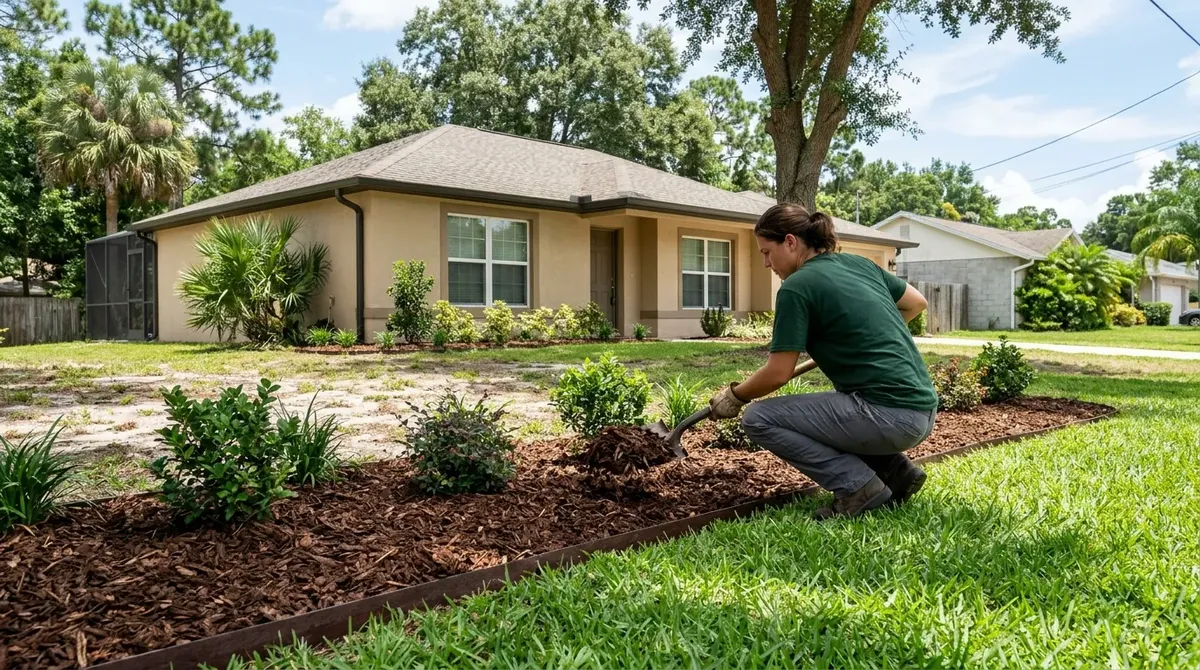
- Mix where it makes sense. Plenty of yards use bark in the front beds for a clean look and straw on the side slopes and under the back pines.
Mixing also helps the budget. Straw covers the big, out-of-the-way areas for less, and the more expensive bark goes where people actually look. If you want both delivered on the same trip, our mulch delivery crews can bring bulk mulch and bales together.
Pine Straw or Mulch: Which Fits Your Lakeland Yard
- Sloped beds, berms or areas under a gutterless roof edge: pine straw.
- Front foundation beds in a deed-restricted neighborhood: pine bark or MSC-certified dyed mulch, which hold a uniform look between top-ups.
- Big natural areas under pines or oaks: pine straw for cost, especially on large lots in places like Bartow with older trees.
- Beds you only want to touch once a year or less: melaleuca or pine bark.
- Paths, drainage swales and downspout splash zones: rock over fabric.
- Vegetable and herb beds: about an inch of undyed organic mulch.
Whatever you pick, keep it at 2 to 3 inches. With watering limited under the current SWFWMD order, a good layer of either one helps beds hold moisture between allowed days. Mulch and straw jobs are booked alongside sod work all over the area; our homepage covers Lakeland sod, mulch and delivery in one place, or you can get a free estimate for your beds.